
Corporate Conference Management in India: How to Plan a High-Impact Business Conference
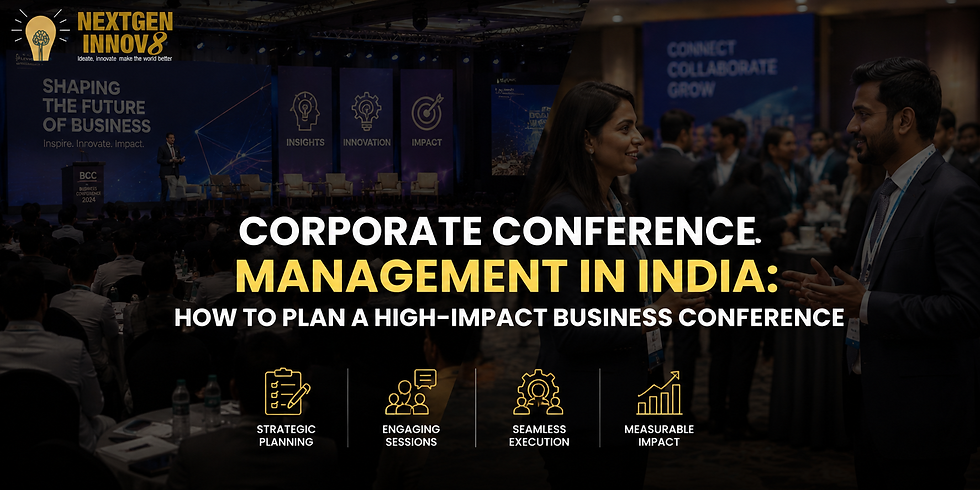
A business conference is one of the most complex and highest-stakes events a company can run. It brings together multiple speakers, a diverse audience, a multi-session agenda, production infrastructure, and simultaneous coordination across logistics, content, and technology — all of which must work seamlessly for an audience that has given up their time to attend.
In India, corporate conference management has matured significantly over the last decade. Companies across technology, pharmaceuticals, financial services, manufacturing, and professional services are now running conferences that rival international standards in production quality, content depth, and attendee experience.
This guide covers everything HR managers, Admin directors, and Marketing heads need to know about planning and executing a high-impact corporate conference in India — from format selection and venue sourcing to agenda design and post-conference follow-up.
What Is Corporate Conference Management?
Corporate conference management is the end-to-end planning, coordination, and execution of business conferences events designed to gather a defined professional audience around a shared theme, agenda, or set of business objectives.
A corporate conference differs from a sales meet in its scale, its content depth, and its audience composition. While a sales meet is primarily internal and motivation-focused, a conference typically spans multiple sessions, multiple speakers, and often a mixed audience of employees, clients, partners, media, and industry professionals.
Types of Corporate Conferences in India
Leadership Summit
A closed, senior-level gathering of C-suite executives and business heads focused on strategy, performance review, and alignment. Typically 50 to 150 attendees, one to two days, at a premium venue. High content-to-production ratio.
Industry Conference
A larger, often open-registration event that brings together professionals from across a sector — technology, healthcare, manufacturing, finance — around shared industry themes. Typically 200 to 2,000 attendees, multi-day, with keynote speakers, panel discussions, and networking sessions.
Client and Partner Conference
A curated gathering of key clients, channel partners, or distributor networks for relationship-building, product updates, and strategy sharing. Combines the intimacy of a VIP event with the structure of a conference.
Internal Business Conference
A company-wide or business-unit-level conference for internal alignment — typically combining a town hall format with breakout sessions, departmental updates, and leadership presentations. Common in large organizations with distributed teams across India.
Step-by-Step: How to Plan a Corporate Conference in India
Step 1 — Define the Conference Objective and Success Metrics
Every conference planning decision — venue, format, content structure, speaker selection, production investment — flows from a clear objective. Define it before anything else. Are you generating leads, building thought leadership, aligning internal teams, or activating a partner network? Each objective produces a fundamentally different conference design.
Define success metrics before you begin planning. Attendance numbers, media coverage generated, leads captured, partner agreements signed, post-conference survey scores — knowing how success will be measured keeps every planning decision anchored to the right outcomes.
Step 2 — Select the Right Format and Duration
Corporate conferences in India typically range from a half-day format for focused internal sessions to three days for large industry events. The most common and effective format for mid-scale corporate conferences — 100 to 500 attendees — is a one-and-a-half to two-day structure with a day one plenary session, breakout workshops, networking dinner, and a day two skills or panel programme.
Step 3 — Source and Secure Your Venue
Venue selection for a corporate conference in India requires evaluation across six parameters. Plenary hall capacity with clear sightlines to the stage. Breakout room availability for concurrent sessions. AV infrastructure quality — in-built sound, projection, and internet bandwidth. Accommodation availability if the conference is multi-day and delegates are travelling. Catering quality and F&B infrastructure. Location and accessibility from major airports and city centres.
For conferences in Pune, top venues include JW Marriott, Conrad Pune, Novotel, and Hyatt Regency. For Bangalore conferences, JW Marriott, ITC Windsor, The Leela, and BIEC for larger-scale events. For destination conferences, Goa, Jaipur, and Udaipur offer the best combination of professional venue infrastructure and environment quality.
Step 4 — Design a Conference Agenda That Maintains Energy
Conference agenda design is the discipline of balancing content delivery with participant energy management. A full day of back-to-back presentations is a guaranteed recipe for disengagement regardless of speaker quality.
Structure your agenda with deliberate energy management in mind. Open with a high-impact keynote that sets the conference's intellectual and emotional tone. Alternate between plenary sessions and smaller, interactive breakouts. Build in structured networking windows — not just coffee breaks, but facilitated interaction designed to create useful connections. End each day on a content high, not an administrative note.
Step 5 — Curate Your Speaker Programme
The speaker programme is the most visible measure of a conference's quality. It should include internal leadership voices for organisational credibility, external industry experts for authority and fresh perspective, and practitioner speakers for practical relevance. The best conference programmes balance inspiration with actionability — attendees should leave with both a shift in perspective and something specific they can apply.
Brief every speaker thoroughly. Provide a speaker guide covering conference theme, audience profile, session length, AV requirements, and content expectations. Conduct a pre-conference speaker briefing 48 to 72 hours before the event.
Step 6 — Plan Technology and Hybrid Integration
In 2026, any corporate conference with a national or international attendee base requires hybrid capability. A well-executed hybrid conference streams the live event to remote attendees with genuine participation tools — live Q&A, polling, virtual networking, and on-demand content access. Remote attendees must experience a first-class event, not a recording of one.
Step 7 — Engage Your Event Management Partner Early
For a conference of 100 or more attendees, engage a professional corporate event management company at least 60 to 90 days in advance. For large conferences above 500 people or multi-city events, 90 to 120 days is the appropriate lead time. Your event partner should be involved from venue sourcing through post-conference debrief — not just engaged for on-day coordination.
What Separates High-Impact Conferences From Routine Ones
The NextGenInnov8 team has produced corporate conferences across Pune, Mumbai, Bangalore, and destination venues for companies spanning technology, manufacturing, pharma, and financial services. The differentiators are consistent.
High-impact conferences begin with a clear commercial objective and design every element to serve it. They treat the networking windows as seriously as the keynote sessions — because the most valuable outcomes of any conference happen in conversations between sessions, not during them. They invest in production quality that signals the conference's seriousness before anyone speaks. And they end with a defined follow-up protocol that converts conference momentum into commercial outcomes within 72 hours.
Frequently Asked Questions
What is the difference between a corporate conference and a corporate seminar?
A conference is a larger, multi-session event typically spanning one to three days with multiple speakers, breakout sessions, and a mixed audience of employees, clients, partners, or industry professionals. A seminar is usually a focused, single-topic session of two to four hours with one or two speakers and a more homogeneous audience. Conferences require significantly more planning, production investment, and logistical coordination than seminars.
How early should I start planning a corporate conference in India?
For conferences of 100 to 300 attendees, begin planning 60 to 90 days in advance. For large conferences above 300 people, destination conferences, or events with complex hybrid requirements, 90 to 120 days is appropriate. Key venue decisions and speaker confirmations should be locked at least 60 days before the event date.
What are the best cities in India for hosting corporate conferences?
Pune, Bangalore, Mumbai, Hyderabad, and Delhi-NCR are India's top cities for corporate conferences due to their concentration of corporate demand, high-quality venue infrastructure, and connectivity. For destination conferences, Goa, Jaipur, Udaipur, and Coorg are consistently popular. City selection should be driven by where the majority of your delegates are based and the nature of the conference.
Should a corporate conference include entertainment?
Entertainment at a corporate conference is effective when it is thematically connected to the conference's content or brand and positioned at a natural energy transition point typically the conference dinner on the evening of Day 1. Entertainment purely for its own sake often feels disconnected from the conference's purpose. The most effective conference entertainment extends the brand experience rather than interrupting it.
Why Execution Is Everything — And Why You Need the Right Partner
A corporate conference with poor execution does not just disappoint attendees. It undermines the credibility of every idea, every strategy, and every speaker that appeared on its stage. Technical failures, agenda overruns, poor speaker management, and disorganized networking windows send a message about organisational standards that no post-event communication can fully reverse.
At NextGenInnov8, we plan and execute corporate conferences with the same rigour we bring to every event we deliver from the initial objective-setting conversation to the post-conference debrief. We handle venue sourcing, agenda design, speaker coordination, AV and production management, hybrid integration, delegate management, and on-ground execution under a single, accountable team.


Comments