
Indoor Corporate Event Ideas for Monsoon Season: Keeping Engagement High in July–August

Here is a belief that quietly costs Indian companies a lot of engagement every year: July and August are not good months for corporate events.
It is not written policy. Nobody says it out loud in a planning meeting. But it shows up in decisions the event gets pushed to October, the team outing moves to December, the workshop idea goes back in the drawer until the rains are over.
The logic feels reasonable. Commutes are unpredictable. Outdoor options are limited. Attendance is uncertain. So companies wait.
What they are actually doing is leaving July and August — two full months of the financial year — without a single intentional engagement touchpoint. No recognition moment, no shared experience, no reason for the team to feel something about the company they work for. And then they wonder why Q3 performance feels flat before it has even started.
The monsoon is not an obstacle to corporate events. For those willing to plan differently, it is the most underused engagement opportunity in India's corporate calendar.
Why Monsoon Is Actually the Smartest Season to Run Corporate Events
Before the ideas, the argument. Because the case for monsoon corporate events in India is stronger than most HR heads realise.
Venues are available — and more negotiable- July and August are off-peak months for most corporate venues. Hotels, conference centres, and indoor event spaces across Pune, Bangalore, Mumbai, and Hyderabad are running below capacity. Booking a quality venue at better rates and getting your preferred date confirmed within days rather than weeks is the quiet financial upside of monsoon events that most planners miss.
The psychological moment is right- Something happens in Indian workplaces when the monsoon arrives. The pace shifts slightly. The morning chai break gets longer. People gather near windows. There is a collective mood that is slower, more reflective, more human. That mood is not a productivity problem. It is a shared experience — and shared experiences are the foundation of genuine team connection. A well-planned indoor event leans into that mood instead of fighting it.
Engagement gaps in July hurt Q3- Companies that run their last engagement event in May or June and pick up again in October are operating with a five-month engagement gap through their most commercially demanding quarters. The teams that perform through Q3 almost always had something in July that reminded them why they are in this together.
Indoor formats often outperform outdoor ones- Not because indoor is inherently better, but because indoor events force more deliberate design. You cannot rely on a beautiful destination to carry the day. The content, the activities, the pacing — all of it has to work. That constraint, when applied with professional planning, consistently produces tighter, more focused, more impactful events.
10 Indoor Corporate Event Ideas That Work in July–August
1. Skill-Building Workshop Day
Pick one skill that is universally relevant to your team communication, presenting with impact, negotiation, creative thinking, or leadership and build a structured half-day or full-day workshop around it. July is a psychologically natural reset point. Teams are mid-year, mid-target, and often operating on autopilot. A skill-building day interrupts that pattern and sends a clear signal: the company is investing in you, not just your output.
The format works because it delivers career value alongside team connection. For Gen Z and millennial employees who represent over 50 percent of India's corporate workforce learning opportunities are a primary engagement driver, not a nice-to-have. 2. Indoor Team Building Games — Designed for Monsoon Energy
The words 'team building' conjure images of rope courses and trust falls. Forget those. Indoor team building in 2026 looks different. Escape room challenges, collaborative problem-solving sessions, competitive trivia built around your company's culture and the monsoon season, creative team competitions like a monsoon playlist challenge or a rain-themed art installation these generate energy and genuine laughter without requiring a single square foot of outdoor space.
The monsoon theme itself is a design advantage. Build activities around it rather than ignoring it. A Bollywood rain songs quiz, a monsoon potluck where teams bring their childhood rainy-day food memories, or a team storytelling competition anchored in the first rain these are low-cost, high-impact, and impossible to replicate in any other season.
3. Mid-Year Recognition Event
July sits almost exactly at the midpoint of the financial year. Most companies have their annual recognition at year-end and nothing in between. This gap is a retention and motivation problem. High performers who do six months of exceptional work without any formal acknowledgement are not invisible; they are actively noticed by the companies paying them. Introducing a mid-year recognition event in July fills that gap and communicates that performance is seen as it happens, not just at appraisal time.
It does not require a gala. A structured two-hour session with a leadership address, a curated set of recognition moments, and a good dinner is enough to generate the loyalty dividend of a full-scale annual event at a fraction of the cost and planning bandwidth.
4. Culture and Creative Evening
A Bollywood dance workshop, a coffee painting session, an improv comedy evening, or a live acoustic performance creative formats break the routine of professional interaction in ways that structured activities cannot. They reveal dimensions of colleagues that conference rooms never will. And they generate the kind of shared memory that employees reference months later.
These formats work particularly well for IT companies, financial services teams, and manufacturing organisations where daily work is cognitively intensive and the team rarely gets to experience each other outside of project contexts. The monsoon evening as a backdrop rain on the windows, warm lighting, chai gives these events a specific atmosphere that makes them feel special without requiring a large production budget.
5. Leadership Connect Session
Not a town hall. Not an all-hands with slides. A genuine, unscripted leadership connect a session where senior leaders sit with small groups of employees and talk. Not about targets. About the company's direction, about what they are watching in the industry, about what they think the next twelve months will demand from the team, and about what they are personally finding hard.
These sessions are rare because they require vulnerability from leadership. They work because that vulnerability builds more trust in two hours than a year of formal communication can. Mid-July, reflective, slightly slower is the natural moment for this kind of conversation.
6. Cross-Department Collaboration Challenge
Most corporate teams operate in silos that are invisible until a cross-functional project exposes them. A structured collaboration challenge where teams from different departments are mixed and given a business problem to solve together in a day breaks those silos deliberately, in a low-stakes context, before they become high-stakes failures.
The problem can be real (a genuine company challenge presented as a hackathon) or simulated (a case study relevant to your industry). What matters is that people who rarely work together are placed in a situation where they must. The social capital built in that room shows up in every cross-department project that follows.
7. Wellness Day — Beyond Yoga
A corporate wellness day in July is not just a nice HR initiative. It is a strategic response to a real pattern: Q1 and Q2 are consistently the most stressful quarters in India's corporate calendar, as teams are adapting to new targets and new structures after the financial year reset. July is the point at which that accumulated pressure needs an intentional release.
Wellness in 2026 has moved well beyond a yoga mat. A half-day wellness program might include breathwork and a guided meditation session, a nutritionist-led session on managing energy across a long workday, a movement activity tailored for office-going bodies, and a reflection segment on personal well-being goals for H2. Done right, employees leave feeling genuinely cared for which is a different feeling from having attended a wellness event.
8. Product or Strategy Deep-Dive Session
July is the midpoint of the financial year. It is when companies should be asking, "Are we executing the right strategy, and does every person in this building understand it clearly enough to execute it well?" A strategy deep-dive session — structured as a working day rather than a presentation gives the leadership team a forum to check alignment and gives employees a genuine understanding of where the company is going in H2.
This format is particularly valuable for sales, marketing, and operations teams who make daily decisions that should be connected to strategic priorities but often are not. An engaged team that understands the company's direction outperforms a disengaged team with the same targets every time.
9. Department Fun Day
Not every engagement initiative needs to be company-wide. A department-level fun day, half a day with a team lunch, a creative or competitive activity, and a short recognition moment is one of the most cost-efficient and consistently effective formats in the engagement toolkit. It is intimate enough to feel personal and flexible enough to be adapted to the team's specific culture and preferences.
For HR teams with distributed budgets and no central engagement budget, department fun days are the format that makes consistent, year-round engagement possible without requiring a large organizational event every time.
10. Learning Lounge — A Curated Reading and Reflection Day
This is the least conventional idea on this list and the one that consistently surprises HR teams when it works. A learning lounge day sets up a curated indoor environment comfortable seating, good coffee, and no laptops for work, where employees spend a half-day reading a book, listening to a curated podcast series, or working through a course that the company has specifically selected for them. The day ends with a structured group discussion where teams share what they found interesting and what they want to apply.
It generates genuine intellectual energy, signals that the company takes growth seriously, and creates a shared reference point for team conversations that lasts months. And in the monsoon, the atmosphere practically designs itself.
What Makes Indoor Monsoon Events Work — And What Kills Them
The difference between a monsoon corporate event that lands and one that feels like a compromise is not budget. It is intent. Events that feel like they were planned because the outdoor option was unavailable feel like a consolation prize. Events that feel like they were specifically designed for this moment, for this team, with this season as a backdrop those are what people remember.
Three things separate the two. First, a clear purpose — the event must know what it is trying to achieve, and every element must serve that purpose. Second, production quality appropriate to the format even a small indoor event benefits from a properly set up space, good acoustics, and the kind of attention to physical detail that says 'we prepared this for you.' Third, a human close the moment at the end of the event that acknowledges the team, the quarter, the season, and what is ahead. That moment is what people carry home. Why Execution Is Everything And Why You Need the Right Partner
The companies that run strong corporate events in July are not doing something complicated. They are doing something deliberate. They have decided that the monsoon months are part of their engagement calendar, not a pause in it and they have found an event partner who can deliver quality in an indoor format without the safety net of a spectacular outdoor setting.
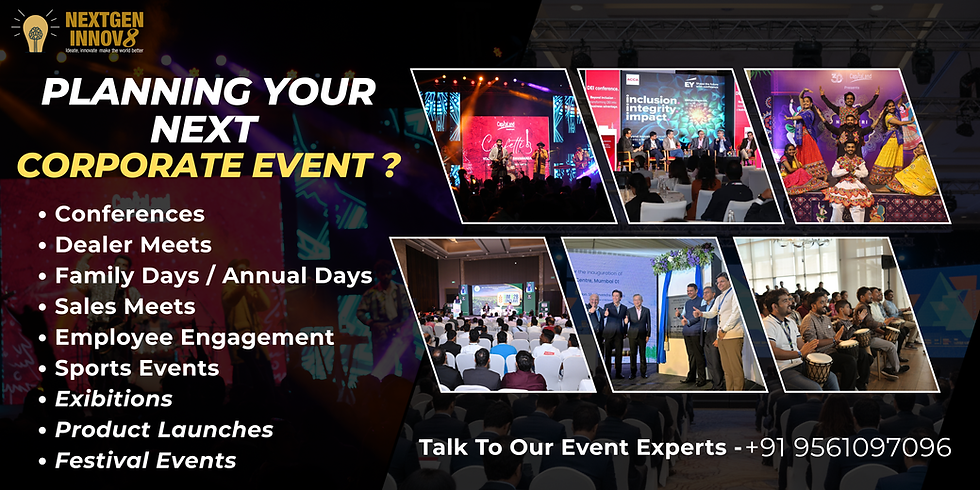
NextGenInnov8 (NGI Events) plans and executes indoor corporate events across Pune, Bangalore, and pan-India including skill-building days, mid-year recognition events, creative and wellness sessions, and leadership engagement formats. We work with HR heads and business leaders who understand that consistency in engagement matters as much as the events themselves.
Conclusion
The monsoon months in India's corporate calendar are not a gap to manage. They are two months of the financial year where your team is in the office, the year's momentum is building, and the shared mood of the season creates a natural opening for events that feel genuinely different from the rest of the year.
The companies that figure this out first are not doing anything extraordinary. They are simply deciding to show up for their teams in July not just in April and October. NextGenInnov8 (NGI Events) would like to help you do that well.
Frequently Asked Questions — Indoor Corporate Events Monsoon India
Q: Can you organise quality corporate events during the monsoon in India?
Yes — and in many cases, the monsoon window offers advantages that other seasons do not. Venue availability is higher, rates are more negotiable, and the season's shared cultural resonance gives indoor events a specific atmosphere that is harder to create in other months. The key is designing for the indoor format deliberately rather than treating it as a fallback.
Q: What are the best indoor corporate event ideas for July and August?
The most effective indoor corporate event formats in monsoon include skill-building workshop days, mid-year recognition events, leadership connect sessions, wellness days, cross-department collaboration challenges, creative evenings such as dance workshops or art sessions, and strategy deep-dive sessions. The right choice depends on what the team needs most at the midpoint of the financial year.
Q: How do you keep engagement high during monsoon months?
By planning intentionally for the July-August window rather than pausing engagement until October. Companies that run at least one structured engagement touchpoint in July consistently see stronger Q3 team cohesion and performance than those who allow a five-month gap between Q1 events and the year-end calendar.
Q: What indoor venues work best for monsoon corporate events in Pune and Bangalore?
In Pune, hotel conference facilities in Koregaon Park, Baner, and Hinjewadi work well for indoor events of 50 to 500 people, with the added benefit of lower rates and better availability in July-August. In Bangalore, properties in Whitefield, Indiranagar, and Hebbal offer strong indoor event infrastructure. For smaller team events, corporate campus common areas and indoor recreation spaces are increasingly being used for workshop days and creative sessions.
Q: How far in advance should we plan a monsoon corporate event?
For indoor events of 50 to 150 people, three to four weeks of planning is generally workable in the monsoon season given higher venue availability. For larger events above 150 people or those with significant entertainment and production elements, six to eight weeks gives the event management team enough time to build something genuinely good rather than adequate.


Comments